Maria Karpushina
Altering Neutrality
Narrators Without Names
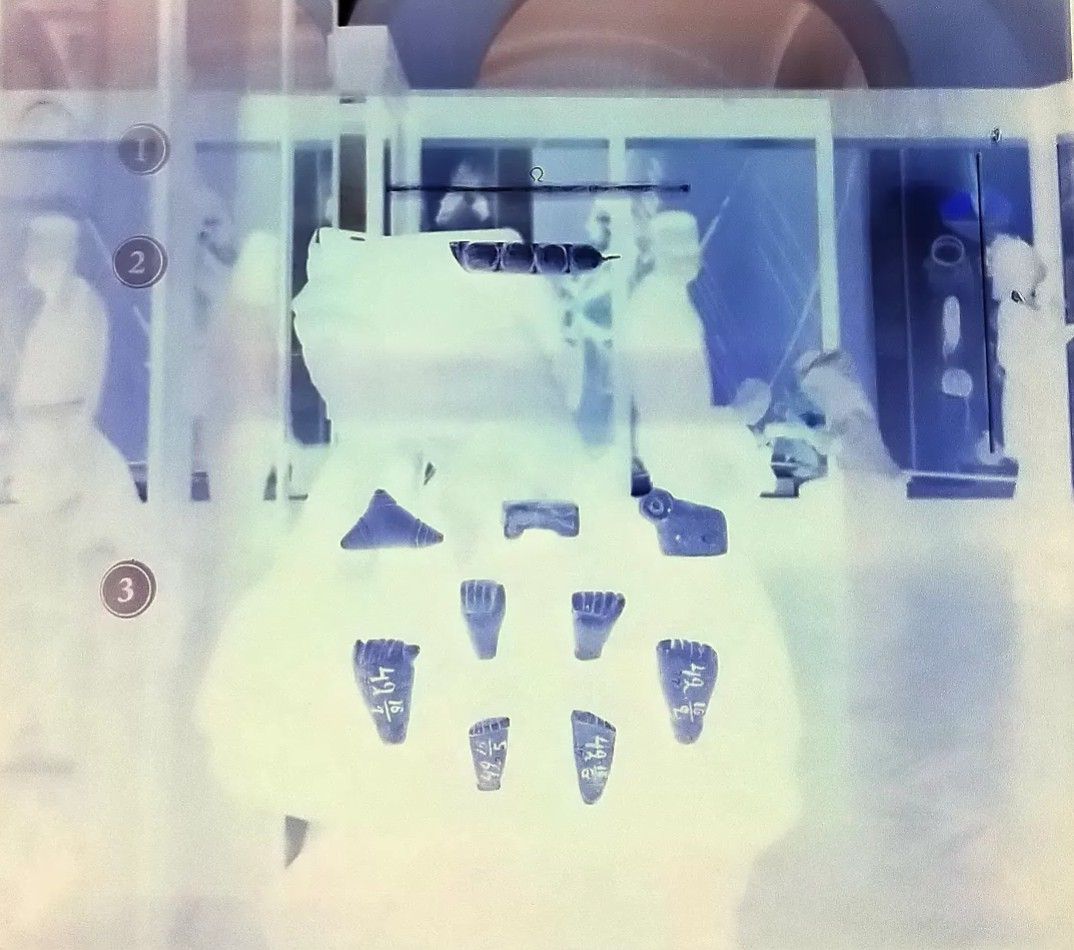
The Ethnological collections grew up from the cabinets of curiosity and tightly bound with an act of narration. Despite the claim to exude a neutral position for the sake of education, the eurocentric museum continually disregards the uncanonical recital on those narratives. In my view, their spatial and epistemological 'neutrality' could not and cannot be construed without violence. In the project ‘Air rushing from our lungs’, that was exhibited during the Meisterschüler*innen year at the University of the Arts Bremen, I have considered the Überseemuseum in Bremen as a space, where political and geo-economical influences have left traces of repression, abuse, and inequality and where museum practice shows itself rooted in Westernized Modernity, between logocentric language, power structures, and translation. The purpose of this Ph.D. research project is to continue this work on ethnological museums and to revise their claim for neutrality.
Cultural institutions represent not just the continuity of governmental agendas with their ideologies, world views, epistemological principles, etc., they exemplify the broader 'mental' agendas that are deeply rooted in the traditions of museums and their origin. Looking at the exhibition space in this manner, I propose to examine several ethnological museums and their displaying practice through key studies. Three museums are chosen as a starting point for this research –– Überseemuseum in Bremen, Germany; Kunstkamera in Saint Petersburg, Russia and Museo del Oro Tairona - Casa de la Aduana in Santa Marta, Colombia.
The ethnological museum became a cultural institution starting from private cabinets of curiosity in the 16th passing by the centuries of industrial fairs to nowadays, carrying with it one force - the mystique act of narration. Despite that this power has a significant learning impact on a massive scale to the wider public, when one goes to the collection today, e.g. Überseemuseum Bremen or Kunstkamera – we see school tours, writings of hegemonic persons, politics towards others, it is clear that these spaces are still trying to teach (t)his dominant vision of history. The bars in the cells, protective glass, surrounding, suffocating, suppressing not only the bodies of artifacts, it ties our bodies and voices up as well.
Debates on restitution began in the 1980s[5]. The “earlier” debate had been silenced, blocked by many ministries and forgotten. For fifty years German museums have been declining and resisted the process of returning objects (even in clearly unethical conditions of holding human remains and ritual objects). Museums pretended that this process is very complicated[6]. Currently, active debates are increasing in a variety of fields, with contributions from activists, researchers and artists. While one museum might take the restitution process as a crucial part of their work in acknowledging the benefits for mutual positions in discourse[7], other cultural institutions prefer to remain neutrally silent. Their excuses range from referring to bureaucracy or complicated threads of ownership to the absurd –– i.e. that places are not qualified for the care of artifacts[8]. Some have even taken the artifacts in question to the closed archives away from the public eye. Furthermore, the western ownership laws and regulations became an issue for those who natively created those artifacts.
Facing the role of hegemony and its spread in western art and knowledge production, a central question in my work regards how strategies can be developed to involve narrators beyond the professional museological field in order to critically engage and challenge the epistemic traditions of imperialistic cultural institutions through artistic practice.
The proposal “Altering Neutrality’ suggests confronting the role of eurocentric cultural institutions and scrutinizing how their neutral position might have been involved in stereotyping, otherness gap production, and the delegitimization of different kinds of non-western knowledge. The intention is to find strategies not only to detect, dissect and expose the hegemonic traces within the epistemological traditions but as well create a space where the void of that otherness gap can be inverted in order for negated forms of knowledge to be implemented.
With these implications and considerations, the research will use a collective strength and for this reason, be realized through Participatory Action Research (PAR) – a research approach that allows to involve those groups and individuals who historically have been excluded. With a focus on museological interventions, the research process will initially be distributed into three parts: displaying, contextualizing and sensorial altering. This project aims to examine what kind of embodied knowledge manifests itself throughout the collaborative practices with the implementation of phenomenological approaches. What manifests here will be considered as a resistant response towards the neutrality claimed and practiced by a majority of cultural institutions using the western model.
Keywords: Epistemological Diversity / Altering Neutrality / Sensorial strategies / Artistic Practice-led Participatory Research / Museum Interventions
[5] Merryman, J. H. 1985. “Thinking about the Elgin Marbles.” Michigan Law Review 83 (8): 1880–1923. doi:https://doi.org/10.2307/1288954.
[6] https://www.arte.tv/de/videos/102461-000-A/raubkunst-restitution-arte-tracks/
[7] Tythacott, L., and K. Arvanitis. 2014. “Museums and Restitution: An Introduction.” In Museums and Restitution: New Practices, New Approaches, edited by L. Tythacott and K. Arvanitis, 1–16. Abingdon: Routledge.
[8] “Restituieren? Afrika Fordert Seine Kunstschätze Zurück - Die Ganze Doku,” ARTE, accessed March 14, 2022, https://www.arte.tv/de/videos/097591-000-A/restituieren-afrika-fordert-seine-kunstschaetze-zurueck/.
Supervisor HfK:
Prof. Dr. Asli Serbest
Supervisor HDK-Valand:
Prof. Dr. Mick Wilson