Ayşe Ateş
Ayse Ates works through tracing, listening, and following. Her practice begins from fragments—oral accounts, chance encounters, material remnants, and overlooked details—through which broader constellations of memory, place, and relation gradually unfold.
Moving across moving image, installation, sound, text, and collaborative formats, she treats artistic practice as an inquiry in formation, where knowledge emerges through process rather than pre-definition.
Her work engages oral histories, fieldwork, and archival materials alongside everyday encounters, attending to what persists after contexts shift or disappear. Traces, absences, and partial transmissions become operative materials rather than evidence of loss.
Collaboration and sustained attention to human and more-than-human environments shape her methodology, where narratives circulate across geographies, temporalities, and forms, held in conditions of uncertainty and encounter.
Ayşe Ateş is a PhD candidate in the Binational Artistic PhD Program at HfK Bremen (University of the Arts Bremen) in cooperation with the University of Groningen.
https://ayseates.com/about
@aysehates
RESUME
EDUCATION
2025, PhD in Artistic Research, HfK Bremen, in cooperation with University of Groningen
2021, Time-Based Media MFA, Hamburg Fine Arts University, Hamburg
2017, Painting MFA, Marmara University Institute of Fine Arts, Istanbul
2013, Painting BA, Marmara University Faculty of Fine Arts, Istanbul
SELECTED SOLO & DUO SHOWS
2026, (Upcoming), To Move, To Carry, To Remain, Duo Show mit Phuong Thao Nguyen, Nachtspeicher 23, Hamburg, DE
2026, (Upcoming), Duo Show with Julia Nordholz, Frise Künstlerinnenhaus, Hamburg, DE
2025, Rooted Else ( ), Duo Show with Cho Ari, Sender, Hamburg, DE
2020, Kendiliğinden / Per Se, Curated by Nergis Abıyeva, Bilsart, Istanbul, TR
GROUP SHOWS
2025,...And Yet We Are Here, Frappant Galerie, Hamburg, DE
2025, Poetiken Des Miteinanders, Stadtgalerie Künstlerhaus, Lauenburg, DE
2024, One Hour Train Ride, Galerie Flut HfK Bremen, Bremen, DE
2024, Hybrid Peace, Mom Art Space, Hamburg, DE
2023, Die Zukunft gehört den Pilzen, Stadtgalerie Künstlerhaus, Lauenburg, DE
2023, Hybrid War, MOM Art Space, Hamburg, DE
2023, Jahresausstellung, HfK Hamburg, DE
2022, Non-Knowledge, Laughter and the Moving Image, ICAT, Hamburg, DE
2022, Rapid Rabbit Reloaded, Frappant Galerie, Hamburg, DE
2022, Jahresausstellung, HfK Hamburg, DE
2020, Duna IG Takeover, Project Duna, Brazil & Spain
2019, Güzeşte, Mixer Arts, Istanbul, TR
2018, Bang. Art Innovation Prix 2018, 42 Maslak, Istanbul, TR
2017, Otomata, Mixer Arts, Istanbul, TR
2017, Young, Fresh, Different 8, Gallery Zilberman, Istanbul, TR
2017, Temporality, Differences and Beyond M.U.F.F.A, 7th International Student Triennial, Kare Art Gallery and Russo Art Gallery, Istanbul, TR
2017, Bang. Art Innovation Prix, ArtBizTech, Istanbul, TR
2016, Borders Orbits 18, Siemens Arts, Istanbul, TR
RESIDENCIES & GRANTS
2026, DAAD, Forschungsstipendien für Doktorandinnen und Doktoranden
2024, Residency.ch, Progr Bern, CH
2023, Examensförderung, Studierendenwerk Hamburg
2022, Project Grant, Freundeskreis Projectförderung
2022, Karl H. Ditze Stiftung
ARTIST TALKS & PERFORMANCES
2026, Reading Performance, KhB Buchmesse, Berlin, DE
2025, Reading Performance, Sender, Hamburg, DE
2024, Reading Performance, ExLibris Independent Book Fair, Hamburg, DE
2024, Artist Talk, Reading Performance, Open Studio, Progr, Bern
2020, Per Se, with Nergis Abıyeva, Bilsart, Istanbul, TR
PUBLICATIONS
2024, Fanzine Project, ‘‘Plant People Unite!’’, by Alexandra Baumgartner & Kim Lang, Photo Forum Pasquart, Biel/Bienne, CH
2024, Jahrbuch, HfbK Hamburg
2024, Roots, Roads, Traces, Artist Book, Self-published
2024, Hybrid Peace Exhibition Catalogue, MOM Art Space
2023, Hybrid War Exhibition Catalogue, MOM Art Space
2019, Güzeşte Exhibition Book, Curated by Bengü Gün
2018, bang. Art Innovation Prix 2018 sergisi açıldı - Published in Unlimited
2017, Otomata Exhibition Book, Curated by Esra Özkan
2017, Sanat üretme sırası robotlarda - Published in Unlimited
2017, Genç Yeni Farklı’nın Sekizinci Yılından Notlar - Published in Artfull Living
2017, 7th International Student Triennial Catalogue
2017, Notes from Istanbul by Özge Çokgezen - Published in Das Arty Berlin
2016, Notes on the Borders and Orbits – Published in Artfull Living
2016, Siemens Sanat’ta Genç Sanatçılar Üretiyor – Published in Gazete Duvar
INTERVIEWS
2017, Pursuing a loss, a new production story, Interview with Burcu Dimilli
PORTFOLIO
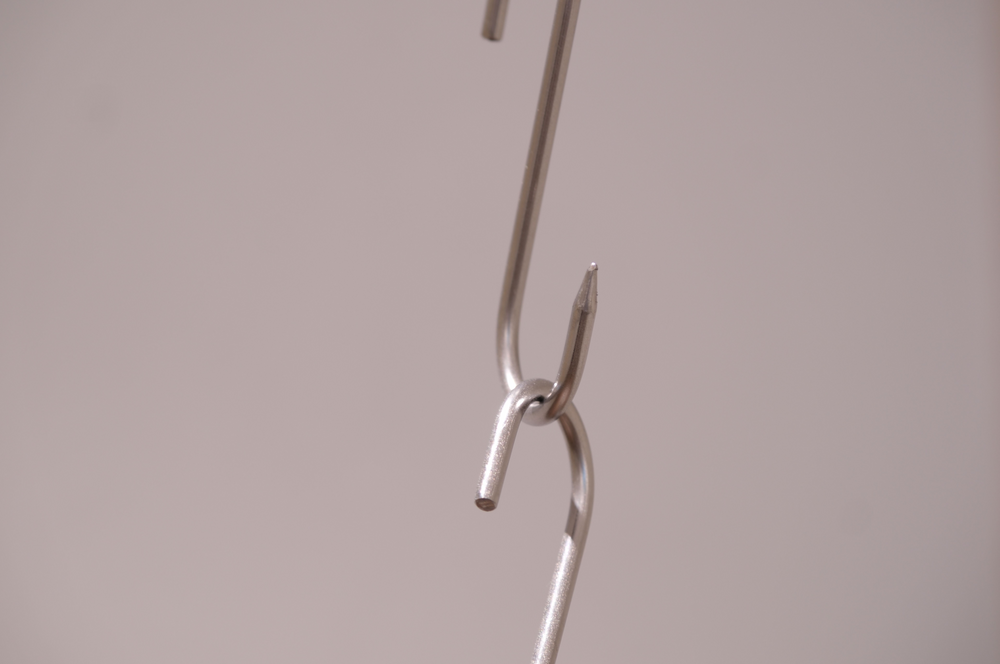
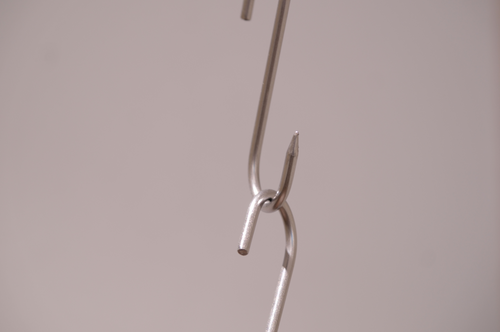
Installation, Steel meat hooks, Dimensions variable, 2026
Steel hooks descend from the ceiling, interlocking as they fall. Stability emerges only through contact, nothing is secured; only transferred.
In Monastir, meat is suspended, salted, pressed, and left to time. What should decay is made to persist. Continuation emerges as a technique of delay. Suspension becomes both a method of preservation and a form of transmission.
Hidaye was displaced from Kayılar in 1923. No archival body documents her. What is missing is what would have been held — only the connection between hooks remains, repeating across domestic speech, without a referent, carrying no fixed point of return.
Hooks continue to fold into one another as they descend. Weight circulates without resolution. Nothing comes to rest; the pile keeps the shape of what passed through it.
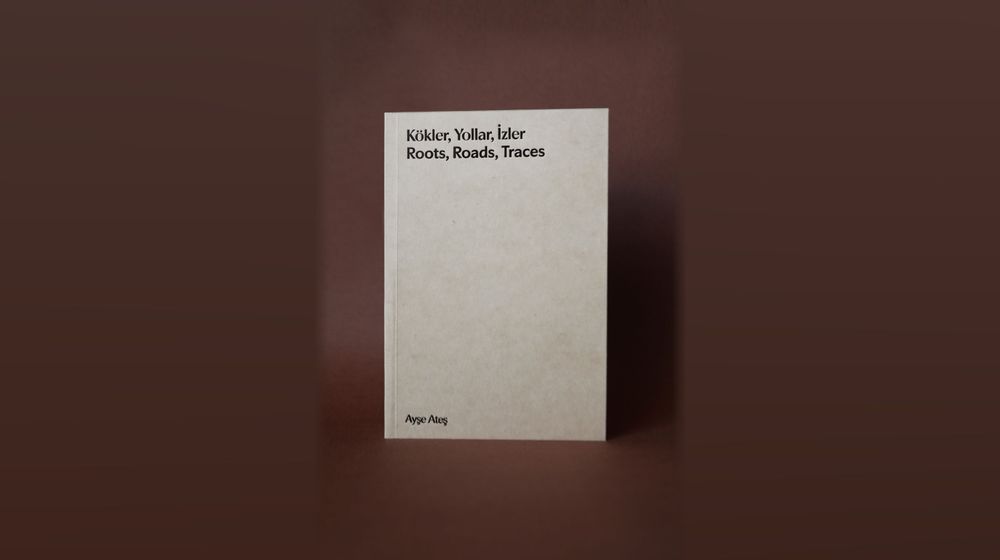
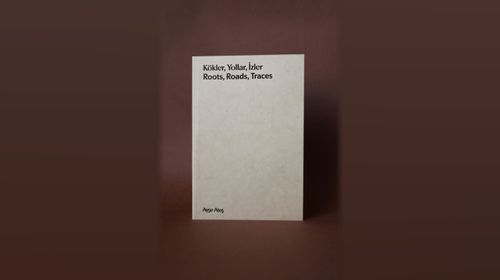
Roots, Roads, Traces, Artist book, 15 Ed., Self-published, Signatured
Soft cover, 14x20 cm, 420 Pages, Turkish & English
Design: Gregor Maria Sahl
2024
The project takes its name from the ''Delice'' (a Turkish word meaning crazy/mad), which grows spontaneously as a wild olive tree in the Aegean region of Turkey. Delice turns into an olive tree when grafted by Zeki, like a healer. This action includes an artisanal approach to olive cultivation, shows not to consume but produce, heal and transform.
Starting from a personal narrative, the project evolves into a long-term research project. It traces a rumored agreement signed between Turkey and Spain in 1951-52 for this special olive species.
Roots, Roads, Traces is written to revisit the places visited during the artistic research, to remember the narratives and share them with the reader. In addition to sharing stories from the personal and institutional archives visited in Turkey and Spain during the research, it is also a written record of the process, a research diary.
https://ayseates.com/works/roots_roads_traces


Single Channel Video, 14'45'', Color and Sound, 2025
The work takes its name from Delice—a Turkish word meaning both “wild” and “mad,” and referring to a variety of untamed olive native to the Aegean region. Through Zeki’s grafting, Delice becomes a cultivated olive tree, a process sustained by the patience and knowledge of craftsmanship. This act—producing, healing, and transforming—opens a space to reconsider the relations between human and non-human, or more-than-human, worlds.
The film portrays Zeki, who has been cultivating olives in the groves inherited from his father for nearly forty years, and his close relationship with the wild Delice olive trees. These trees, often seen as marginal, reveal through his care a different way of understanding continuity, resilience, and transformation.
Delice also carries the layered connections shaped by my long-standing familiarity with this family in Küçükkuyu, where I have spent my summers since childhood. The film unfolds through Zeki’s gestures in the groves and my own lived experience of the place, where human and tree, memory and practice, intertwine to form a shared narrative.